

Have you ever had a moment in your life when you wondered whether you might be sabotaging yourself? Or when someone suggested that a certain behavior, attitude, or perspective of yours might come from self-sabotage?
And then… what did you do with that idea? Did considering it helped you in any way?
Recently, my therapist suggested that some of the thoughts I was having could be forms of self-sabotage. That made me start asking myself: what exactly is self-sabotage? Why do we do it? How does it work? What are the mechanisms behind it? And, most importantly, how can we prevent it — or at least reduce its impact on our lives?
That’s how I came across The Big Leap, by Gay Hendricks.
In the book, Hendricks presents an analogy to explain self-sabotage and offers a model to understand its mechanisms, its typical manifestations, and how we can overcome them.
Since I’ve been trying to write more here, I decided to share what I learned about self-sabotage (the “thermostat” in our minds), the hidden triggers of the Upper Limit Problem, and its most common forms — according to an author I really enjoyed reading.
What Is Self-Sabotage? The Thermostat in Our Minds
A thermostat is a device that controls heating and cooling systems to keep a room within a desired temperature range.
For example, inside a sandwich maker there is a thermostat that turns off the heating element when it gets “too hot,” and turns it back on when it cools down — keeping the plate warm without exceeding a certain limit.
Gay Hendricks argues that we have a similar mechanism in our minds.
We each have a certain internal limit for how much happiness, abundance, and self-satisfaction we feel comfortable experiencing. When we go beyond that level for too long, we tend to unconsciously create reasons to bring ourselves back down.
That is what he calls self-sabotage.
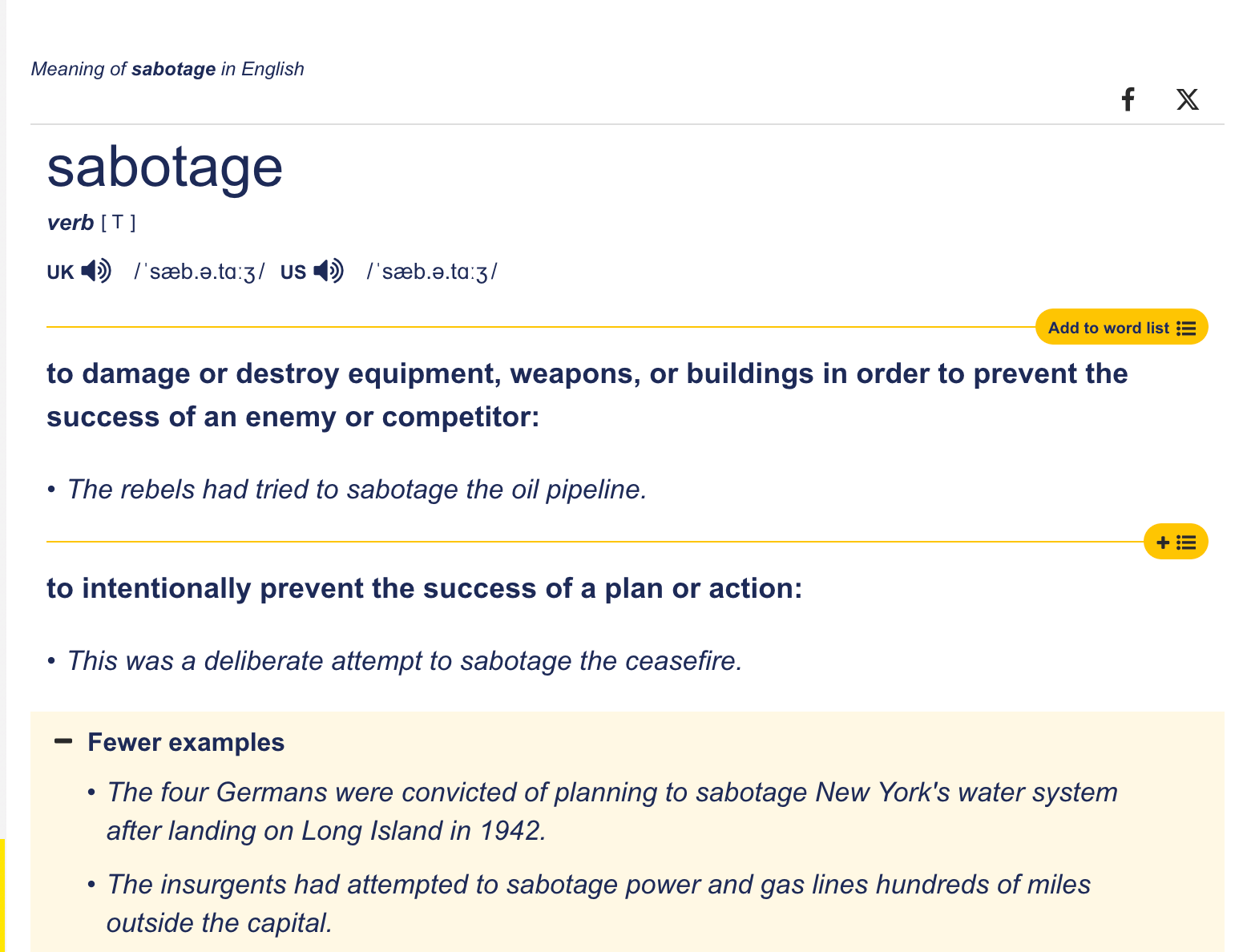
If we look at the definition of “sabotage,” we find expressions such as:
“to damage or destroy equipment, weapons, or buildings in order to prevent the success of an enemy or competitor”
“to intentionally prevent the success of a plan or action”
This is important.
When we self-sabotage, we are — often unconsciously — taking actions that slow us down, interrupt our progress, or undermine ourselves from within. The more hidden this process is, the more effective it becomes.
Hendricks explains this using the thermostat analogy: we have an “upper limit” set in our emotional system. When positive emotions, success, or fulfillment exceed that limit, we activate behaviors that bring us back to what feels “normal.”
This is what he calls the Upper Limit Problem (ULP).
Hidden Barriers and Triggers of the Upper Limit Problem
One of the most striking ideas in the book is that, according to Hendricks, the main problem we need to solve in life is the Upper Limit Problem. If we solve it, everything else becomes easier.
To help us recognize when we are hitting this limit, he identifies a set of core beliefs that act as triggers for our internal thermostat.
These are the four main “hidden barriers.”
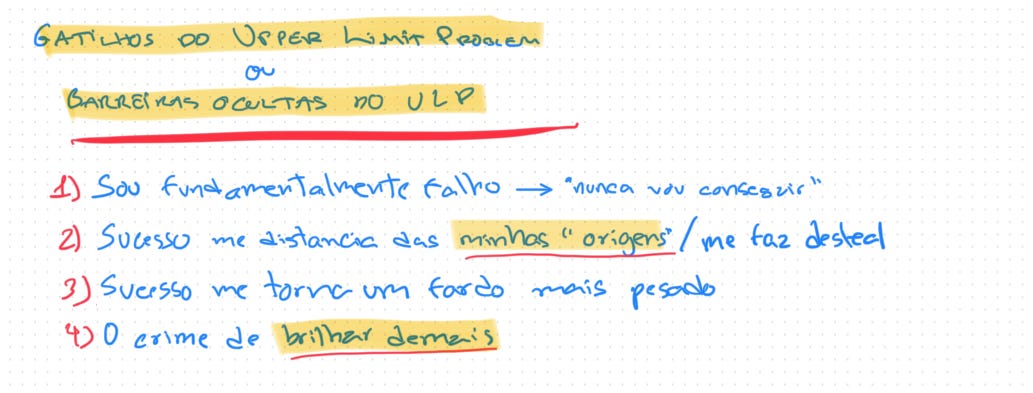
1) “I Am Fundamentally Flawed” → “I’ll Never Make It”
This belief is the idea that something is intrinsically wrong with us — something permanent, unfixable, built into who we are.
When we believe this, we tend to think:
“I’m just not made for this.”
“I’ll never really succeed.”
“Something always goes wrong with me.”
It doesn’t make logical sense. But emotionally, it can feel very real.
It’s not rare. Many of us have had this thought at some point — even if only occasionally.
2) “Success Makes Me Disloyal to My Roots”
Sometimes, when we start succeeding, we feel as if we are betraying where we came from.
We may unconsciously ask ourselves:
“Am I breaking some unwritten rule in my family?”
“Am I disappointing my parents by becoming different?”
“Am I leaving my people behind?”
This barrier is about loyalty — real or imagined.
I experience this sometimes myself. Over time, I’ve learned that what matters most to me is being at peace with my own story: knowing where I come from, where I am, and where I want to go.
Being conscious of the narrative I’m building with my life — even if only for myself.
3) “Success Makes Me a Heavier Burden”
In the book, Hendricks shares personal stories about feeling like a burden to his family.
His father died shortly after he was conceived. His mother was unemployed, had another child, and fell into depression. As a child, he internalized the idea that his existence was “too much” for others.
Years later, he realized he was carrying guilt for things that were never his responsibility.
The unconscious “mantra” behind this barrier is:
“I can’t expand to my highest potential because I’d be an even bigger burden than I am now.”
When we believe this, we limit ourselves to avoid “weighing on others.”
4) The “Crime” of Shining Too Brightly
According to Hendricks, this barrier is common in talented children.
They receive praise and attention, but also subtle messages like:
“Don’t show off.”
“Don’t make others feel bad.”
“Be careful not to stand out too much.”
Over time, this becomes an internal rule.
The unconscious mantra is:
“I must not expand to my full success, because if I did, I would outshine ______ and make them look or feel bad.”
As adults, this can show up as holding ourselves back to protect other people’s feelings.
We don’t fully use our potential because we fear making someone else uncomfortable.
I also like to reflect on another angle here:
Are we sometimes overestimating our own importance?
Or underestimating the strength, agency, and potential of others?
Maybe other people are more capable of handling our success than we think.
Conclusion
This article is just a brief introduction to the ideas in The Big Leap.
I tried to summarize the main concepts behind self-sabotage using the thermostat analogy and to present the key hidden barriers that define our “upper limit.”
In a future article, I may explore more about how these triggers are activated — like understanding the internal “switch” that makes the thermostat kick in.
Hendricks also talks about four “zones” of operation:
Zone of Incompetence
Zone of Competence
Zone of Excellence
Zone of Genius
That’s another fascinating topic worth exploring later.
I strongly recommend the book. And if you’ve made it this far, I hope this text was useful to you.
Until next time.
References
“I can’t expand to my highest potential because I’d be an even bigger burden than I am now.”
The Big Leap, Gay Hendricks, HarperOne, 2009, p.52.
“I must not expand to my full success, because if I did I would outshine ______ and make him or her look or feel bad.”
The Big Leap, p.55.